For many grease manufacturers in the United States, the hardest part of product development is not manufacturing.
It is knowing which formulation direction actually works in the real market.
A mid-sized lubricant company in Fresno understood this problem very well.
The company had spent years supplying industrial lubricants and standard-purpose greases to agricultural equipment operators, trucking fleets, and industrial maintenance contractors across California and neighboring states. They knew their customers closely. Their sales team regularly heard the same complaints from end users operating equipment under high heat conditions:
- Grease hardening too quickly
- Oil separation during long service cycles
- Bearing failures under sustained heat
- Inconsistent lubrication performance
- Oxidation issues in high-temperature environments
- Frequent relubrication requirements
- Grease leakage under heavy load
Their customers wanted a grease that could survive hotter operating temperatures while maintaining stability and lubrication consistency.
The company knew there was strong demand for a premium high-temperature grease product — but they also understood how risky grease formulation development could become if approached blindly.
Instead of spending years experimenting internally, they chose a much more efficient strategy:
They identified a commercially successful high-temperature grease already performing well in the field, reverse engineered the formulation, optimized it around their manufacturing capability, then developed their own proprietary production version.
That approach dramatically reduced technical uncertainty, shortened development time, and lowered commercialization risk.
This case study explains how analytical benchmarking and formulation optimization through FormulationAnalysis.com helped the company move from concept to commercial production with far less cost and risk than traditional lubricant R&D.
The Company Already Understood the Market — They Needed Faster Technical Direction
One reason this project succeeded is because the client already understood their customers exceptionally well.
They were not guessing what the market wanted.
Their industrial and agricultural customers specifically requested:
- Higher drop point performance
- Better oxidation resistance
- Reduced oil bleed
- Longer lubrication intervals
- Improved thermal stability
- Better resistance under sustained load
- Consistent grease texture during heat cycling
The company’s challenge was not market demand.
The challenge was technical formulation execution.
Their internal development attempts quickly encountered common grease formulation problems:
- Thickener instability
- Excessive oil separation
- Grease softening under heat
- Difficult manufacturing consistency
- Oxidation-related hardening
- Poor pumpability
- Inconsistent penetration values
Each small adjustment created unintended side effects elsewhere in the formulation.
Eventually, management realized they needed real analytical insight into how successful high-temperature grease products were actually constructed.
That is when they began working with Chemical Reverse Engineering Services.
Why High-Temperature Greases Are Technically Difficult
Many people outside the lubricant industry assume grease is simply “thick oil.”
In reality, high-performance grease systems are highly engineered materials balancing multiple interacting components:
- Base oils
- Thickener systems
- Oxidation inhibitors
- Extreme pressure additives
- Anti-wear systems
- Corrosion inhibitors
- Tackifiers
- Polymer modifiers
- Friction modifiers
- Thermal stabilizers
Small differences in formulation architecture dramatically affect performance outcomes such as:
- Drop point
- Oxidation resistance
- Oil separation
- Thermal degradation
- Mechanical stability
- Water resistance
- Load-carrying capacity
The client specifically wanted to compete in higher-performance industrial applications, meaning the formulation needed to perform consistently under elevated operating temperatures for extended periods.
Without analytical benchmarking, developing that type of grease internally would likely require years of trial-and-error experimentation.
Reverse Engineering a Proven Market Product
Rather than starting from zero, the client selected a high-performing commercial grease already respected within industrial maintenance markets.
Their thinking was practical:
“If a product is already succeeding commercially in demanding environments, understanding its formulation architecture gives us a much stronger development starting point.”
This is increasingly common among mid-sized industrial chemical manufacturers.
Using Lubricant and Grease Formulation Analysis Services, we analyzed:
- Thickener chemistry
- Base oil composition
- Additive package structure
- Oxidation control systems
- Thermal stability components
- Viscosity behavior
- Oil separation characteristics
- EP additive systems
Analytical techniques included:
- FTIR spectroscopy
- GC-MS analysis
- Thermal characterization
- Rheological evaluation
- Elemental analysis
- Oil extraction profiling
- Thickener identification
Through our FTIR Analysis Services and GC-MS Chemical Analysis Services, the client gained a much clearer understanding of the technologies responsible for the benchmark product’s performance.
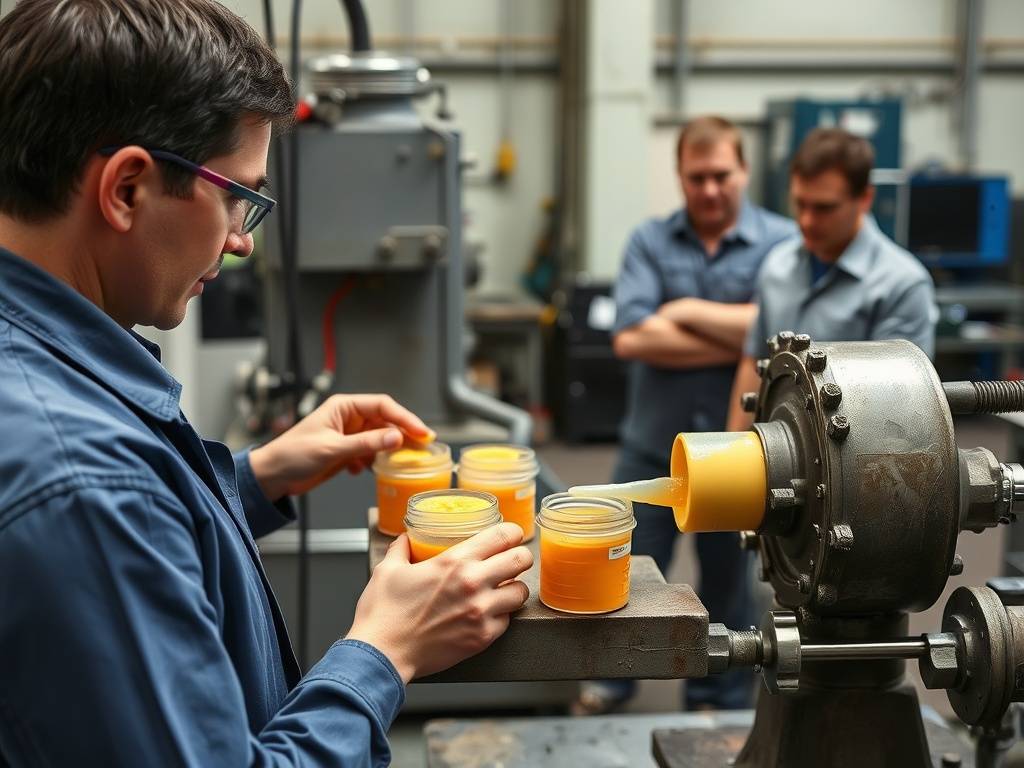
One Major Discovery: Thermal Stability Was Coming from System Balance — Not One “Magic Ingredient”
Initially, the client believed the competitor grease probably used a proprietary additive unavailable to smaller manufacturers.
The analysis revealed something more important.
The benchmark grease achieved high-temperature stability through overall formulation balance:
- Carefully selected base oil viscosity
- Optimized thickener structure
- Controlled additive interactions
- Proper oxidation inhibitor balance
- Stable thermal behavior during extended cycling
The client’s previous development attempts had focused too heavily on individual additives rather than system architecture.
This is one of the most common reasons grease projects fail internally.
Oil Separation Was Another Critical Problem
Several of the client’s early pilot formulations suffered from excessive oil bleed during storage and elevated temperature exposure.
This created multiple commercial concerns:
- Packaging mess
- Inconsistent lubrication
- Customer perception issues
- Reduced long-term stability
The benchmark product demonstrated significantly better oil retention characteristics.
Our analytical work helped identify formulation factors contributing to that stability, allowing the client to redesign the grease system more effectively.
Optimizing the Formula for Their Own Manufacturing Process
After the analytical benchmarking phase, the project moved into optimization through Formulation Optimization Services.
Importantly, the client did not want to create an exact copy.
They wanted:
- Comparable performance
- Better manufacturing practicality
- Raw material sourcing flexibility
- Consistent batch production
- Lower production risk
- Their own proprietary commercial product
The formulation was therefore adjusted around the company’s actual production equipment, supply chain access, and target applications.
This stage proved critical because many laboratory grease formulations become unstable when scaled into commercial kettles and production systems.
The optimized formula focused on:
- Improved oxidation resistance
- Better mechanical stability
- Controlled oil separation
- Enhanced thermal durability
- Reliable manufacturing repeatability
- Improved long-service consistency
Pilot Testing and Field Validation
The client then produced several internal pilot batches for field testing with existing industrial customers.
Applications included:
- Agricultural bearings
- High-load industrial equipment
- Fleet maintenance systems
- Conveyor systems
- Elevated temperature machinery
Customer feedback showed substantial improvement compared to the company’s older grease products.
Users specifically reported:
- Longer grease life
- Reduced relubrication frequency
- Better high-heat consistency
- Lower equipment downtime
- Improved resistance to breakdown under load
That validation gave the client confidence to move into larger-scale manufacturing.
Commercial Launch and Market Expansion
Within months, the company officially launched its new high-temperature grease line targeting:
- Agricultural maintenance distributors
- Industrial lubrication suppliers
- Fleet maintenance operations
- Heavy equipment service providers
The new product line helped the company:
- Expand into higher-margin lubricant categories
- Compete against larger national brands
- Improve distributor confidence
- Strengthen customer retention
- Increase repeat industrial accounts
Most importantly, the company avoided years of uncertain internal R&D.
Instead of blindly testing hundreds of additive combinations, they used analytical intelligence and competitive benchmarking to accelerate commercialization.
Why Reverse Engineering Reduces Product Development Risk
Many chemical manufacturers underestimate the financial impact of failed formulation projects.
The real costs often include:
- Delayed product launches
- Raw material waste
- Failed pilot production
- Lost market opportunities
- Technical troubleshooting expenses
- Weak product performance in the field
Using Competitive Product Analysis Services allows companies to make development decisions using real-world formulation intelligence.
For lubricant manufacturers especially, this approach can dramatically reduce development time while improving commercialization confidence.
Supporting Industrial Lubricant Manufacturers
At FormulationAnalysis.com, we support reverse engineering and optimization projects involving:
- High-temperature greases
- EP greases
- Lithium complex greases
- Calcium sulfonate greases
- Industrial lubricants
- Synthetic lubrication systems
- Heavy-duty equipment greases
- Bearing lubrication products
- Industrial maintenance lubricants
- Specialty thermal lubrication systems
Our Lubricant Reverse Engineering Services help manufacturers shorten development cycles while reducing technical uncertainty and commercialization risk.
Looking to Develop Your Own Lubricant or Grease Product?
Whether you are improving an existing grease formula or launching a new industrial lubrication product, analytical benchmarking can significantly reduce development time and technical risk.
We help companies:
- Reverse engineer grease formulations
- Analyze additive systems
- Improve thermal stability
- Optimize manufacturing scalability
- Troubleshoot grease failures
- Benchmark against market-leading products
- Accelerate product commercialization
Contact FormulationAnalysis.com
Website:
FormulationAnalysis.com
Reverse Engineering Services:
View Reverse Engineering Services
Formulation Optimization:
Formulation Optimization Services
Competitive Product Benchmarking:
Competitive Product Analysis Services
Contact Our Laboratory:
Contact Our Team