Industry: Personal Care / Hair Care Client Type: U.S.-based e-commerce brand (DTC) Product Category: Leave-in hair treatment cream Challenge: Replicate and improve a best-selling imported formulation at domestic scale Outcome: Successful product launch within 90 days, 34% reduction in formulation cost, compliant U.S. labeling from day one
The Challenge: A Best-Seller They Couldn’t Source
Our client — a mid-sized direct-to-consumer beauty brand selling through Amazon and their own Shopify store — had identified a gap in the market. A popular imported hair treatment cream was generating strong sales in their niche, but the overseas supplier had long lead times, unpredictable MOQs, and no interest in white-labeling.
The brand had tried twice to develop a comparable product from scratch with a domestic formulation consultant. Both attempts failed to replicate the texture, slip, and moisture retention that made the reference product so effective. After eighteen months and significant spend, they were no further forward.
When they came to FormulationAnalysis LLC, they had one clear goal: understand exactly what was in that cream, improve on it where possible, and get to a U.S. contract manufacturer with a workable brief.
Step 1: Compositional Analysis — Building the Full Ingredient Picture
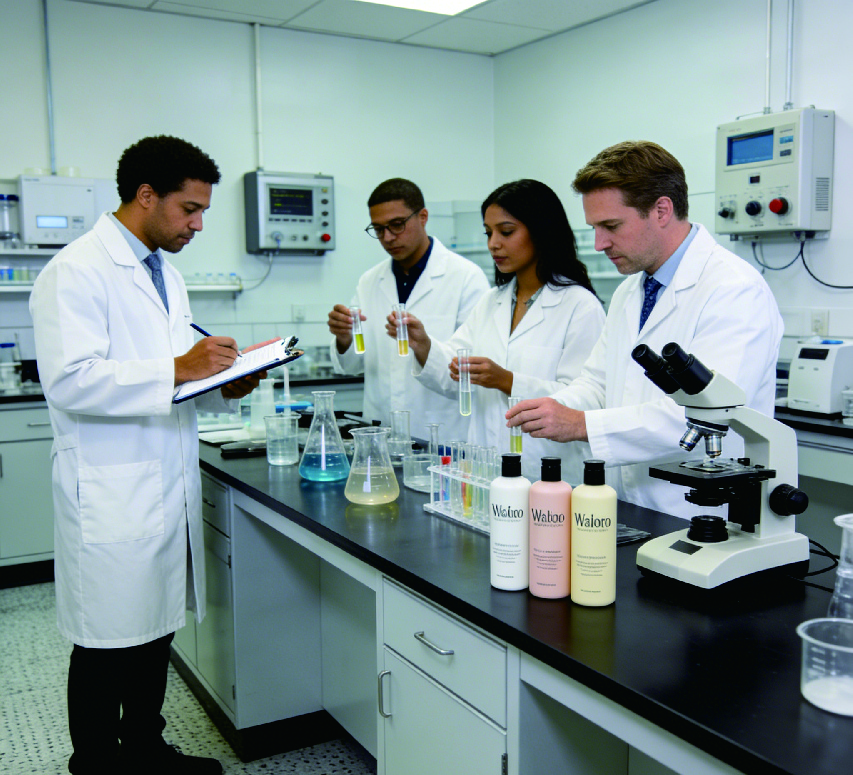
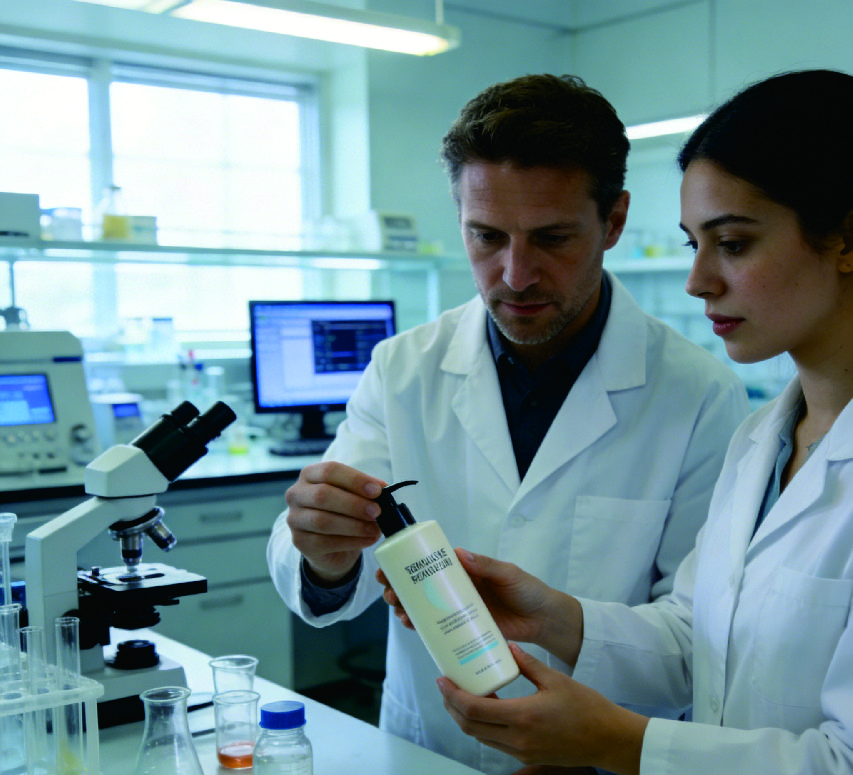
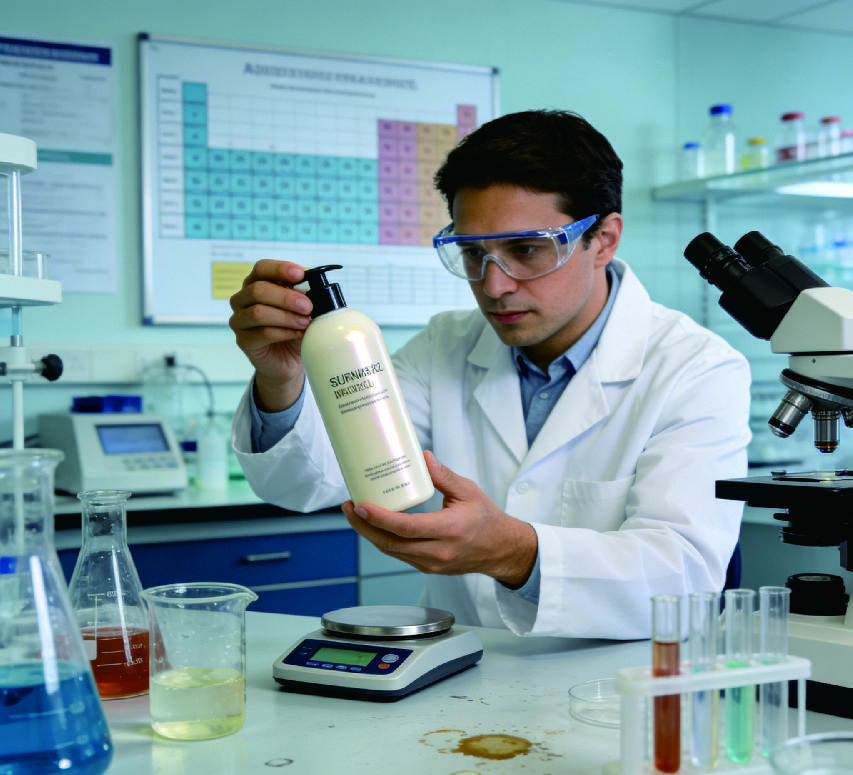
The client submitted two units of the reference product to our Kentucky receiving facility. Within 48 hours of receipt, our laboratory work began.
We applied a multi-method analytical approach to the sample:
- GC-MS (Gas Chromatography–Mass Spectrometry) to identify volatile and semi-volatile organic compounds, including fragrance components and light conditioning agents
- HPLC (High-Performance Liquid Chromatography) to quantify key active ingredients including panthenol, hydrolyzed proteins, and preservative systems
- FTIR (Fourier Transform Infrared Spectroscopy) to characterize the polymer backbone, emulsifier system, and fatty acid profile
- pH and viscosity profiling to establish performance benchmarks
The analysis revealed a more complex formulation than the INCI list suggested. The product contained a dual-emulsifier system combining a cetyl alcohol/behentrimonium chloride base with a secondary polyglyceryl ester — a combination that explained the unusually stable, non-greasy feel that the client’s previous development attempts had missed. A fragrance compound present at a low but detectable concentration was also flagged as a potential skin sensitizer under current EU and proposed U.S. fragrance guidelines.
What the client learned: The reference product’s performance edge was not in its active ingredients — it was in its emulsifier architecture. And one ingredient in the original posed a regulatory risk they had not previously identified.
Step 2: Risk Identification and Regulatory Flagging
Before optimizing anything, we identified two issues that needed to be addressed before any U.S. commercial launch:
Issue 1 — Fragrance sensitizer: A component of the fragrance blend had been flagged by the International Fragrance Association (IFRA) for restriction at certain use levels. The concentration in the reference product was borderline. For a U.S. DTC brand targeting a broad consumer audience including sensitive skin users, we recommended removal and substitution.
Issue 2 — Preservative concentration: The preservative system used a phenoxyethanol/ethylhexylglycerin blend at a concentration that, while common in international formulations, sits at the upper end of what U.S. clean beauty retailers and Amazon’s restricted substances policy typically accept. Reformulating to a slightly lower concentration with a co-preservative would give the client optionality across retail channels.
By catching these issues at the analysis stage — before any manufacturing had occurred — the client avoided the cost and delay of a post-production reformulation, estimated by their CMO contact at between $8,000 and $15,000 depending on batch size.

Step 3: Formula Optimization
With the full compositional picture in hand, our team worked with the client to develop an optimized brief for their contract manufacturer. The goals were:
- Replicate the texture and performance of the reference product
- Substitute the flagged fragrance component with an IFRA-compliant alternative
- Adjust the preservative system for broader retail channel compatibility
- Identify ingredient substitutions to reduce raw material cost without affecting performance
On the cost side, the analysis identified that two of the conditioning agents in the original formulation — both specialty imports — could be replaced with domestically sourced functional equivalents with comparable INCI profiles and no perceptible performance difference in bench testing. This substitution alone reduced the projected raw material cost by approximately 34%.
The optimized formulation brief we delivered included:
- Full ingredient list with recommended concentration ranges
- Supplier-neutral INCI descriptions suitable for direct use in CMO briefing documents
- Phase-in and processing notes (emulsification temperature, mixing sequence, pH adjustment parameters)
- Suggested U.S.-compliant label language including ingredient declaration and usage directions
Step 4: Supporting the Contract Manufacturing Handoff
One of the recurring pain points for emerging DTC brands is the gap between “we have a formula” and “a manufacturer can actually make this.” Formulators speak one language; CMOs speak another.
We supported the client’s manufacturing handoff by preparing a CMO-ready technical brief that translated our analytical findings into a format their shortlisted contract manufacturers could act on immediately. This eliminated two rounds of back-and-forth that typically consume three to five weeks in a standard product development cycle.
The client issued RFQs to three U.S.-based contract manufacturers within one week of receiving the brief. All three responded within the standard window. First production samples were evaluated within six weeks of our original report delivery.
The Outcome: Market-Ready in 90 Days
From the date our client submitted the reference sample to the date their first production batch was confirmed, the total elapsed time was 87 days.
By their own estimate, their previous development approach — working from scratch with a consultant — would have required a minimum of nine to twelve months to reach the same point, assuming it succeeded at all.
Key outcomes:
- 34% reduction in projected raw material cost versus the reference product’s estimated input cost
- Two regulatory risks identified and resolved before any manufacturing spend was committed
- Full U.S. labeling compliance from the first production batch
- Domestic supply chain established, eliminating import lead time and minimum order constraints
- Product listed on Amazon and the brand’s Shopify store within 30 days of first batch approval
The brand has since submitted two additional products for analysis — a scalp serum and a co-wash conditioner — as part of an ongoing product line expansion strategy.
What This Case Illustrates
Reverse engineering a competitor’s formulation is not about copying. It is about understanding. When you know precisely what a successful product contains — and why it performs the way it does — you can make informed decisions: where to improve, where to substitute, where the risks lie, and how to move quickly and confidently to market.
For e-commerce brands operating in competitive personal care categories, formulation intelligence is a legitimate and increasingly common strategic tool. The brands that win are not always the ones that formulate from scratch. They are the ones that move fastest with the best information.
Ready to Analyze Your Reference Product?
If you have a product you want to understand, replicate, or improve — or if you are planning a product launch and want to pressure-test your formulation before committing to a manufacturing run — FormulationAnalysis LLC can help.
We work with e-commerce brands, private label developers, contract manufacturers, and importers across the United States. All projects are handled under strict confidentiality. NDA available upon request.
FormulationAnalysis LLC 📧 info@formulationanalysis.com 📞 (859) 216-8899 📦 Sample Receiving: 2225 Global Way, Hebron, KY 41048 🌐 www.formulationanalysis.com
Serving clients across the United States. Typical report turnaround: 10–20 business days. Contact us to discuss your project.